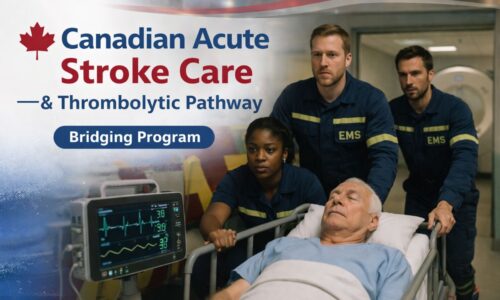
A 36-hour, self-paced online bridging program designed to strengthen rapid stroke recognition, emergency triage, Canadian fast-track workflows, NIHSS scoring fundamentals, imaging interpretation essentials, and thrombolytic pathway readiness based on Canadian best practice recommendations.
The Canadian Acute Stroke Care & Thrombolytic Pathway Bridging Program provides evidence-based learning aligned with Canadian emergency stroke workflows, including rapid triage, “Code Stroke” activation, and time-sensitive decision-making aimed at improving clinical coordination in acute ischemic stroke.
Learners will strengthen readiness in stroke recognition, NIHSS basics, imaging interpretation essentials (CT/CTA/CTP concepts), thrombolytic pathway principles (rtPA/TNK), and practical process design—then apply this learning through case-based scenarios and guided adaptation to local health systems (e.g., Iran, Africa, and other regions).
Stroke is a major cause of death and disability worldwide. In acute ischemic stroke, time-sensitive assessment and coordinated response (“time is brain”) can significantly improve outcomes. This program supports learners in understanding Canadian stroke best practice concepts and translating them into organized, locally feasible pathways.
Core Stroke Pathway Skills
Thrombolysis & Advanced Care Concepts
Learning Materials
Videos, guideline-based learning, case studies, quizzes, and a final integrated assessment.
Assessment
Modular quizzes + final exam / integrated stroke simulation (summative assessment).
Participants who successfully complete the program will receive a Certificate of Achievement
issued by Richmond Hill College – Canada.
This certificate recognizes program completion and learning outcomes and does not grant clinical privileges, licensure,
or authorization to practice.
Outcomes depend on local policy, available resources, and scope-of-practice rules.